Odo

Odo of Bayeux was the half-brother of William the Conqueror. He was made bishop in his teens and held positions of state where he responsible for much of the planning, preparation and execution of the invasion of England. At his peak, Odo was the second most powerful man in the Norman empire. After the conquest, Odo became Earl of Kent and owned Luddesdown Court and later also Rochester Castle. He later fell from grace and lost land and authority. Odo was one of the nobles who supported the claim of Robert of Normandy to England’s throne in 1088 and was banished from England. It was whilst on Crusade with Robert that Odo died, in 1097.

The Bayeaux Tapestry
It is likely that Odo commissioned the Bayeux tapestry, produced within his Earldom of Kent for display in Bayeux Cathedral.
Bishop Odo often appears in the thick of the fighting, waving a club and encouraging his followers. Odo uses a club rather than a sword as bishops were not supposed to shed blood.

Rochester Castle
Situated on the nearby River Medway and Watling Street, Rochester was a strategically important royal castle. During the late medieval period, it helped protect England's south-east coast from invasion. The first castle at Rochester was founded in the aftermath of the Norman Conquest. It was given to Bishop Odo, probably by his half-brother William the Conqueror.
It remains a magnificent example of Norman architecture - very much the archetypal Castle. In fact, Odo himself ended up garrisoning himself here, before being put to siege by William Rufus (William the Conquerors son), and then surrendering and taking exile.
The Round Tower (not visible here) was a replacement built by Henry III to repair the damage done to the keep by King John's mine. In contrast to the other two towers visible, it is cylindrical.
Sources:
1. Rochester Castle - Wikipedia

Luddesdown Court
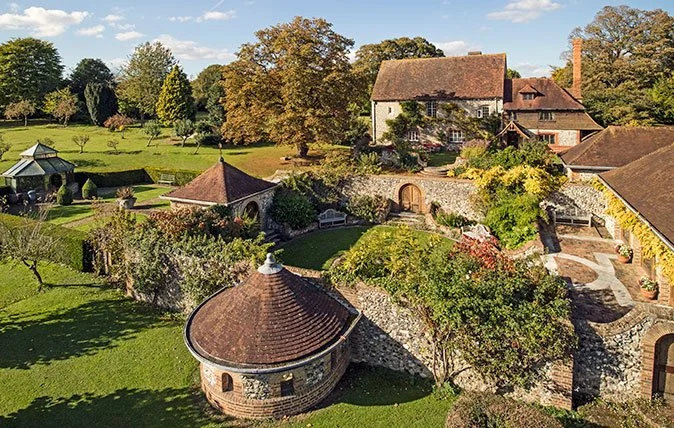
Laying claim to the longest continually inhabited house in England, this was originally owned by Odo and dates back to the 1000s, this exceptional Grade One listed house boasts a remarkable history as well as many original and historical features. A striking and substantial property, this flint and stone built home also benefits from spectacular, far-reaching views across the Kentish countryside.
Source:
1. About – Luddesdown Court

Great Hall, Luddesdown Court
The Great Hall is an essential feature of this historic property, supported by oak beams, with five large windows across the vaulted room. Further important features of this house include the Tudor chimney, Norman corbelled fireplace, and perhaps most importantly, the unique murals scratched into the plaster of the Great Hall and two of the five bedrooms. At the end of the Great Hall is a staircase which leads to a Minstrels’ Gallery.
Source:
1. About – Luddesdown Court
-
The Normans were originally Vikings, specifically Norsemen from Scandinavia, who settled in what is now France in the 10th century. In 911, the Viking chieftain Rollo was granted land in exchange for converting to Christianity and defending against other Viking raids, leading to the establishment of Normandy. Over time, the Normans assimilated into French culture while maintaining some of their Norse heritage.
-
The Norman Invasion, particularly the Conquest of England in 1066, was a significant historical event for several reasons:
Change in Leadership: The invasion led to the end of Anglo-Saxon rule in England and the establishment of Norman control under William the Conqueror. This shift in leadership changed the political landscape of the country.
Feudal System: The Normans introduced the feudal system in England, which transformed land ownership and governance. This system was marked by a hierarchy of lords and vassals, fundamentally changing social and economic structures.
Cultural Transformation: The invasion brought Norman culture, language, and customs to England, which blended with the existing Anglo-Saxon culture. This led to significant changes in the English language, governance, and societal norms.
Architecture: The Normans are known for their distinctive architectural style, which included the construction of stone castles, cathedrals, and churches. This not only established military bases across England but also influenced building designs in the following centuries.
Domesday Book: The invasion also set the stage for the creation of the Domesday Book in 1086, a great survey of England that provided a detailed record of landholdings and resources. It played a crucial role in administration and governance.
Impact on the Church: The Normans also restructured the Church in England, leading to increased ties with the continent and the establishment of Norman bishops, which influenced religious practices and institutions.
Overall, the Norman Invasion was a turning point in English history that reshaped the country's political, social, and cultural fabric.
-
First the Norman Conquest initiated an 850 year long period of almost continuous hostility with our neighbours across the Channel. At least officially, this only finished in 1914 when the dispatch of the British Expeditionary Force at the start of the First World War represented the first time a substantial British army had been sent to France in its defence, rather than for its conquest.
This rivalry with France drew Britain much more, than might have been the case, into the orbit of European affairs and, in large measure, has helped define the axis of our relationship with the Continent.
The second and most striking contribution is to the development of the English language. Without the Normans we (and a lot of the rest of the world) would be speaking something closer to Dutch. English’s amazing breadth of vocabulary is, in large, the product of a fusion between Old English and Norman French.
The Welsh, Scots and Irish have less to thank the Normans for than most. It is perhaps over optimistic to claim that the Anglo-Saxons would have been content to leave their Celtic cousins in peace for ever but there is no doubt that the Normans brought a new aggressiveness to English imperialism, first through the activities of the Marcher Lords and in later times through the actions of conquering monarchs such as Henry II (who started the conquest of Ireland) and Edward (1 (about whom we Welsh know all too much).
The Normans could be claimed to the authors of the deep sense of class consciousness which is so central, even today, to character of England. They changed the system of land ownership to a feudal model which embedded the rights of aristocrats (mainly those who came over with William the Conqueror) and the definitely subservient position of those in serfdom to them. Not that Anglo-Saxon England was exactly the land of the free but the social gradients of that society were less marked and may have led to a different evolution of social relationships in this country.
Finally the Normans and their successors did leave a very significant architectural legacy. The Normans were great builders, both of castles and cathedrals. Who can fail but to be impressed with creations such as the White Tower of London and Ely Cathedral.
Source:
1066 and all that – What did the Normans ever do for us? | ybrumro (wordpress.com)